
Starting a business in Ghana has become more structured and accessible in recent years, thanks to digital reforms and streamlined processes introduced by the country’s business registration authorities. Yet, for many aspiring entrepreneurs, the process can still feel confusing without clear guidance. From choosing a business structure to securing tax compliance, each step plays a crucial role in ensuring a business is legally recognized and able to operate without restrictions.
In Ghana, business registration is primarily handled by the Office of the Registrar of Companies (ORC), formerly under the Registrar-General’s Department. The process is designed to ensure that businesses operate within the law, contribute to national revenue, and are properly documented for transparency and accountability.
The first step in registering a business in Ghana is deciding on the appropriate legal structure. Entrepreneurs must choose whether to operate as a sole proprietorship, partnership, or a limited liability company. A sole proprietorship is the simplest form and is owned by a single individual, making it ideal for small-scale businesses. Partnerships involve two or more people sharing ownership and responsibilities. A limited liability company, on the other hand, is a separate legal entity that offers more protection for owners and is commonly preferred by businesses seeking to grow or attract investment.
Once the structure is chosen, the next step is to conduct a business name search. This involves submitting proposed business names to the ORC to determine availability. The name must be unique and must not conflict with existing registered entities. If approved, the name is reserved for a limited period, giving the applicant time to complete the registration process.
After securing a name, applicants must obtain a Tax Identification Number (TIN). In Ghana, the TIN is essential for all business transactions involving government agencies, banking institutions, and tax authorities. In many cases, the Ghana Card PIN now serves as the TIN, simplifying identification and registration processes.
The next stage involves preparing the necessary documentation. For sole proprietorships, this typically includes basic personal identification, business details, and registration forms. For companies, more detailed documents are required, including company regulations, details of directors and shareholders, registered office addresses, and identification documents for all principals involved.
Applicants are then required to complete the relevant registration forms provided by the ORC. These forms capture key details such as the nature of the business, ownership structure, capital information, and operational objectives. Accuracy at this stage is essential, as errors or omissions can lead to delays or rejection of the application.
After submission, the applicant is required to pay the necessary registration fees. The cost varies depending on the type of business being registered, with sole proprietorships generally costing less than limited liability companies due to their simpler structure.
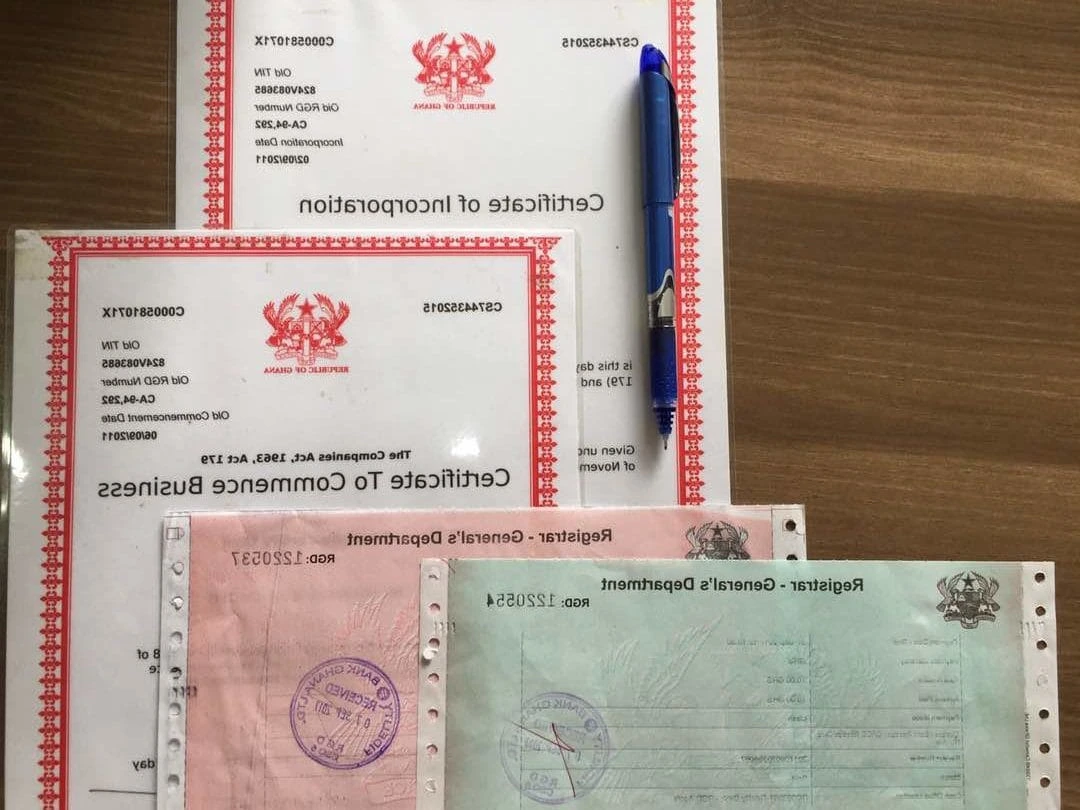
Once payment is made and documents are submitted, the ORC reviews the application. If all requirements are met, the business is officially approved and issued with a certificate of registration or incorporation. In the case of companies, additional documentation such as a certificate to commence business may also be provided.
However, registration does not end at incorporation. Newly registered businesses must also comply with tax obligations by registering with the Ghana Revenue Authority (GRA). This includes income tax registration, and where applicable, Value Added Tax (VAT) and Pay-As-You-Earn (PAYE) registration for businesses with employees. Compliance with tax laws is a critical requirement for operating legally in Ghana.
Businesses that employ workers must also register with the Social Security and National Insurance Trust (SSNIT), ensuring that employees’ pension contributions are properly managed and recorded.
With all regulatory steps completed, business owners can then proceed to open a corporate bank account using their registration documents. This allows them to separate personal and business finances, improve financial management, and build credibility with clients and financial institutions.
Despite improvements in the system, experts note that many entrepreneurs still face challenges due to incomplete documentation or lack of awareness of the full process. As a result, careful attention to detail remains essential for a smooth registration experience.
In conclusion, registering a business in Ghana is a structured but manageable process that requires compliance with legal, tax, and administrative requirements. While it may involve several steps, each stage is designed to formalize business operations and provide entrepreneurs with a solid foundation for growth. For those willing to follow the process carefully, Ghana offers a supportive environment for turning business ideas into legally recognized and scalable ventures.