
There is a certain look people in Ghana give when they hear, “Go to Korle Bu.” It is not fear exactly. It is more like emotional preparation. You start thinking about long queues, missing folders, delayed lab results, overcrowded wards, unavailable beds, and the possibility that after waiting for hours, someone may still tell you to “come tomorrow.”
That reaction alone explains why Ghana’s health system still leans heavily on private healthcare, even after decades of investment in public hospitals and the introduction of the National Health Insurance Scheme (NHIS).
Across Accra, Kumasi, Takoradi and even smaller towns, private hospitals, maternity homes, diagnostic centers and specialist clinics have quietly become the first choice for many Ghanaians who can afford them. The irony is that Ghana technically has a public healthcare system that is supposed to be accessible to everyone. Yet in practice, a huge number of people still pay out of pocket for care at private facilities because they believe public healthcare either moves too slowly or lacks the quality they need.
The dependence is so deep that private health facilities now form a major part of healthcare delivery in Ghana. According to data from Ghana Health Service and the Ministry of Health over the years, private facilities account for a significant percentage of healthcare services in urban areas, especially outpatient care, maternal services and diagnostics. In some communities, private clinics are actually more visible and accessible than government hospitals.
One major reason is simple: pressure on public hospitals has become overwhelming.
Ghana’s population keeps growing, but public healthcare infrastructure has not expanded at the same pace. Cities are growing faster than the hospitals serving them. A facility designed decades ago for a smaller population now handles thousands of patients daily. This creates congestion that affects almost every part of healthcare delivery.
Patients wake up at dawn just to secure folders. Nurses become overworked. Doctors attend to impossible numbers of people in a single shift. Emergency wards become crowded. Sometimes even basic hospital beds become unavailable.
Private hospitals saw this gap and stepped in.
Instead of spending an entire day at a public hospital, some people prefer paying extra at a private clinic where they can see a doctor in under an hour. For many working-class Ghanaians, time itself has become a healthcare expense. Missing work for an entire day at a public facility can cost someone more money than simply paying for faster care privately.
This is why private healthcare is no longer viewed as luxury alone. It has become a convenience system.
Another uncomfortable truth is that many Ghanaians simply trust private facilities more when it comes to attention and customer care.
In many government hospitals, healthcare workers operate under pressure, frustration and exhaustion. Patients sometimes complain about rude attitudes, poor communication and lack of urgency. Not every public healthcare worker behaves this way, of course, but the perception has grown strongly enough that private hospitals now market themselves around friendliness, speed and comfort.
Healthcare in Ghana has quietly become customer-service driven.
Walk into many private clinics and you immediately notice the difference: cleaner waiting areas, shorter queues, better communication and more organized systems. Some even offer WhatsApp appointment booking, digital records and home services. Meanwhile, many public hospitals still struggle with paper folders and manual systems.
Technology has widened the gap further.
Private hospitals are often quicker to adopt modern diagnostic equipment because they operate like businesses competing for patients. MRI scans, fertility services, specialist consultations and advanced imaging are increasingly dominated by private centers. Public hospitals still provide many of these services, but delays and equipment breakdowns push people elsewhere.
Then there is the NHIS problem.
When NHIS was introduced in 2003 under the government of John Agyekum Kufuor, it was seen as a breakthrough that would reduce the financial burden of healthcare. And to some extent, it did. Millions of Ghanaians gained access to healthcare they previously could not afford.
But years later, frustrations around NHIS have become part of the reason private healthcare continues to dominate.
Many private hospitals either do not fully accept NHIS or limit the services covered because reimbursement delays from the state can take months. Some facilities complain that payments arrive late while operational costs continue rising. Drugs, equipment and utilities all cost money immediately.
As a result, patients are often told certain scans, medications or procedures are “not covered.” In reality, many Ghanaians still pay significant cash out of pocket despite being insured.
According to World Bank and WHO estimates over the years, out-of-pocket healthcare spending in Ghana remains relatively high compared to what many citizens expect from an insurance-based system. That creates a strange healthcare reality where people hold NHIS cards but still save money for private treatment.
There is also the issue of doctor migration and dual practice.
Many Ghanaian doctors and specialists work in public hospitals during the day and private hospitals afterward. Some eventually leave the public sector entirely because private practice pays better and offers less pressure.
This creates a talent imbalance.
A specialist shortage in a public hospital can mean waiting months for appointments, while a private facility may offer quicker access if the patient can pay. The healthcare worker is often the same person. The difference is the system surrounding them.
The rise of Ghana’s middle class has also changed healthcare expectations.
Young professionals, entrepreneurs and salaried workers increasingly want healthcare experiences that feel efficient and personalized. They are less patient with overcrowded waiting rooms and bureaucratic delays. Private healthcare has adapted to this demand aggressively.
Even pharmacies are evolving into mini private healthcare centers. Across Ghana, many people now visit pharmacies before hospitals because it is cheaper, faster and less stressful. Some pharmacists unofficially diagnose conditions, recommend treatments and manage minor illnesses. It reflects both creativity and desperation inside the healthcare system.
Rural healthcare tells another story entirely.
In many rural communities, private healthcare dependence looks different. Sometimes it is not about luxury or convenience. It is simply about absence. Some government facilities are too far away, understaffed or poorly equipped. Small private maternity homes, clinics and mission hospitals end up carrying huge responsibilities for entire districts.
Faith-based hospitals especially play a massive role in Ghana’s healthcare structure. Organizations like the Christian Health Association of Ghana have become essential to healthcare delivery in areas where government presence is limited.
The dangerous part of this private dependence is inequality.
If speed, comfort and better treatment increasingly belong to people who can pay, healthcare slowly becomes divided by income. Wealthier patients move quickly through the system while poorer citizens remain trapped in overcrowded public facilities.
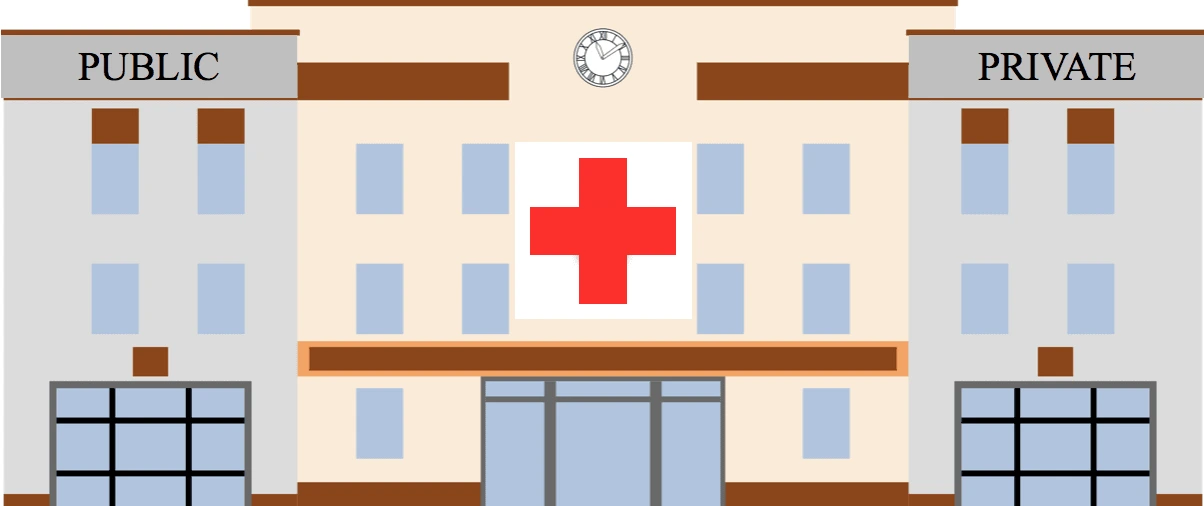
The result is a silent two-tier healthcare system.
One Ghana treats illness with speed. The other waits in line.
And yet, despite all these challenges, public hospitals still carry the country’s biggest healthcare burdens. Major surgeries, emergencies, trauma care, teaching hospitals and national disease outbreaks still depend heavily on government facilities. During crises, it is usually the public system that absorbs the pressure.
That means the issue is not that Ghana’s public healthcare system is useless. Far from it. The real issue is that it is overstretched.
Fixing the problem goes beyond building new hospitals. Ghana’s healthcare system needs faster insurance reimbursements, better working conditions for health professionals, stronger investment in equipment, digital modernization and expansion of healthcare infrastructure outside major cities.
There is also a need to reduce the strange divide between public and private healthcare. Right now, they often operate like parallel systems instead of partners solving one national problem.
Because the truth is this: private healthcare in Ghana did not grow this powerful by accident. It grew because millions of people felt they had little choice.
And until public healthcare becomes faster, more trusted and less exhausting to navigate, private care will continue to dominate not just as an alternative, but as the system many Ghanaians secretly believe works better.