
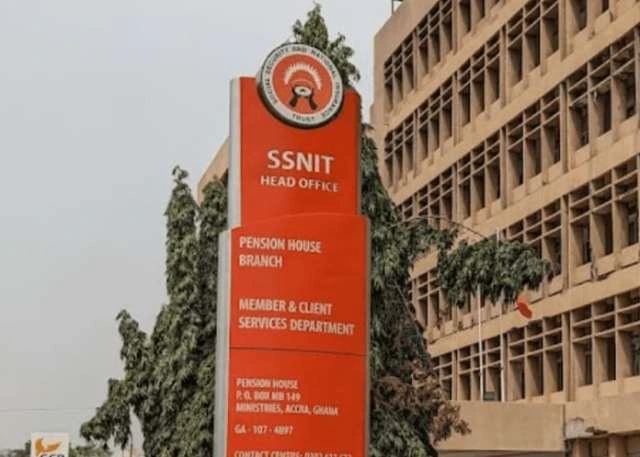
The Social Security and National Insurance Trust (SSNIT) has raised the maximum insurable earnings ceiling for Ghana’s public pension scheme from GH¢52,000 to GH¢69,000, taking effect in 2026.
The upward revision complies with Section 63 of the National Pensions Act, 2008 (Act 766), which requires SSNIT to conduct periodic reviews of the maximum salary level used for calculating pension contributions. Section 66 of the legislation also calls for regular reviews to account for current economic and labour market realities.
SSNIT said the new threshold follows “a detailed actuarial and economic assessment,” which examined salary distributions among active contributors, inflation patterns, interest rates, and the long-term effects of pension indexation.
“The objective is to maintain the financial sustainability of the scheme while ensuring fairness to contributors,” the Trust said.
Significance
Under SSNIT’s structure, a member’s initial pension is primarily linked to earnings and computed based on the average of the contributor’s best three years’ salaries. Pension experts describe the maximum insurable earnings threshold as an essential policy instrument.
“An effective salary capping policy protects the scheme from salary inflation risk,” SSNIT officials explained. “Uncontrolled salary inflation can seriously undermine the financial integrity of a defined benefit pension scheme.”
Industry watchers point out that the lack of a salary cap under the previous PNDC Law 247 led to disproportionately large pensions for certain retirees.
“There was no salary capping policy under PNDC Law 247, and many of the highest pensions today can be traced to retirees who exited the system under that regime,” a pension policy expert noted.
Previous Adjustments
The maximum insurable earnings have been revised multiple times since Act 766 came into force. The cap was initially set at GH¢20,000 and remained unchanged from 2011 to 2016. It was subsequently increased to GH¢25,000 for 2017–2020, then adjusted to GH¢35,000 for 2021–2022, and raised to GH¢42,000 in 2023. The ceiling was set at GH¢52,000 for 2024 and 2025 before the current increase to GH¢69,000.
Excess Contributions Issue
Pension researchers have highlighted continuing policy gaps despite the increase. A major concern centres on the rising number of contributors whose salaries surpass the maximum insurable earnings.
“The number of workers earning above the cap runs into several thousands,” said Abdellah Mashud, Executive Director of the African Centre for Retirement Research (ACRR). “Regulations require that contributions on earnings above the SSNIT cap should be credited to the worker’s Tier Two account, but our assessments show that this is often not being done.”
Mashud warned that the failure to credit these excess contributions “reduces the net retirement benefits of affected workers and undermines confidence in the pension system.”
Calls for Legislative Clarity
Pension specialists are advocating for more explicit legal provisions on how maximum insurable earnings are established.
Mashud proposed that upcoming pension reforms should clearly outline the methodology and formula for determining the cap.
“Embedding the method in law would align Ghana’s pension system with international best practices, including the International Labour Organization’s Convention 102,” he said. “It would also improve transparency and accountability among all stakeholders.”
The latest adjustment by SSNIT is anticipated to spark renewed discussion on equity, sustainability, and governance in Ghana’s pension system as talks on the next phase of pension reforms intensify.