
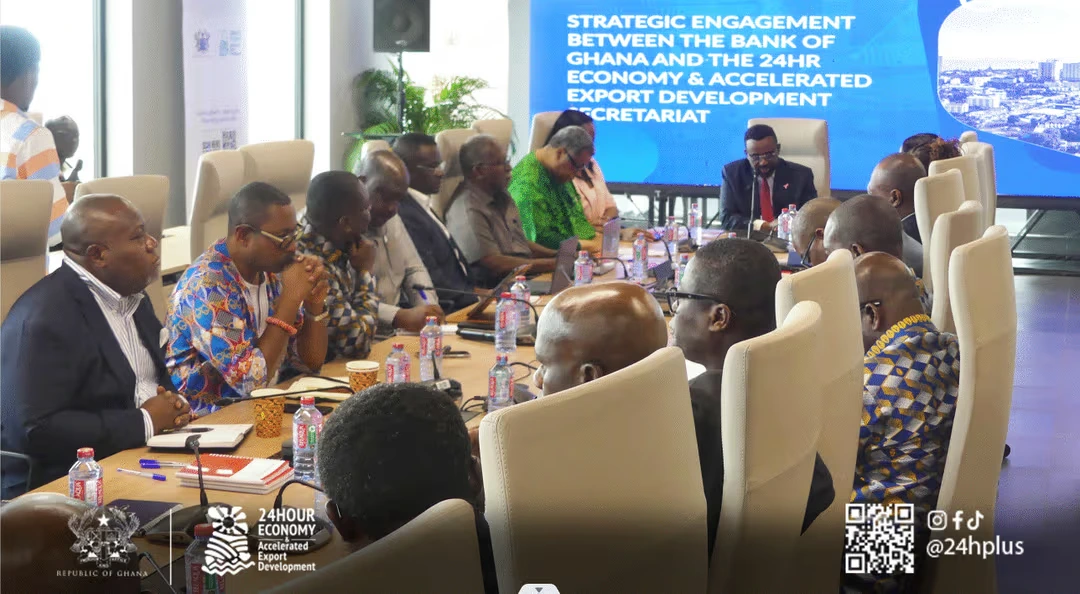
The 24-Hour Economy Secretariat has conducted a high-level discussion with the Bank of Ghana to ensure the flagship policy is coordinated with the nation’s wider macroeconomic framework.
The meeting is part of the Secretariat’s continued stakeholder consultations aimed at presenting the 24-hour economy policy details, gathering institutional input, and establishing strategic partnerships for execution. The central bank is among the most recent institutions consulted as the initiative moves into its implementation stage.
Goosie Tanoh, Presidential Advisor on the 24-Hour Economy Programme, thanked the Bank for allowing engagement with its leadership and technical personnel.
He noted that Ghana’s immediate priority is to build a resilient economy anchored on macroeconomic stability. He praised the Bank of Ghana for delivering the stability necessary to create platforms for growth, expansion, and increased economic activity, including higher domestic production and export output.
He explained that the 24-hour economy initiative is intended to deepen these gains by providing a targeted micro-level response to the macroeconomic stabilization achieved. He characterized recent economic indicators as notable, pointing to sustained treasury bill performance and a decline in inflation as evidence of a strengthening foundation for long-term growth.
A central topic of discussion was the proposed creation of a Food Security and Price Stabilisation Fund. The Fund is anticipated to help moderate commodity price volatility, reduce food inflation, and enhance national food security, complementing existing monetary policy measures.
The session also examined practical collaboration opportunities between the Secretariat, commercial banks and the central bank. Ideas discussed included developing a 24H+ credit policy and enterprise financing framework, coordinated appraisal of credit requests, syndicated and direct lending opportunities, and balance sheet support for eligible 24-hour enterprises subject to due diligence.
Other topics addressed included recognition of credit insurance schemes to strengthen collateral frameworks, regulatory considerations for 24-hour loan portfolios, foreign exchange hedging instruments to support SME lending at reasonable rates, and digital platforms to expand access to trade and finance.
The discussions with the Bank of Ghana are expected to yield important strategic regulatory policy initiatives that will strengthen the financial services infrastructure under which Ghanaian companies are expected to thrive.