
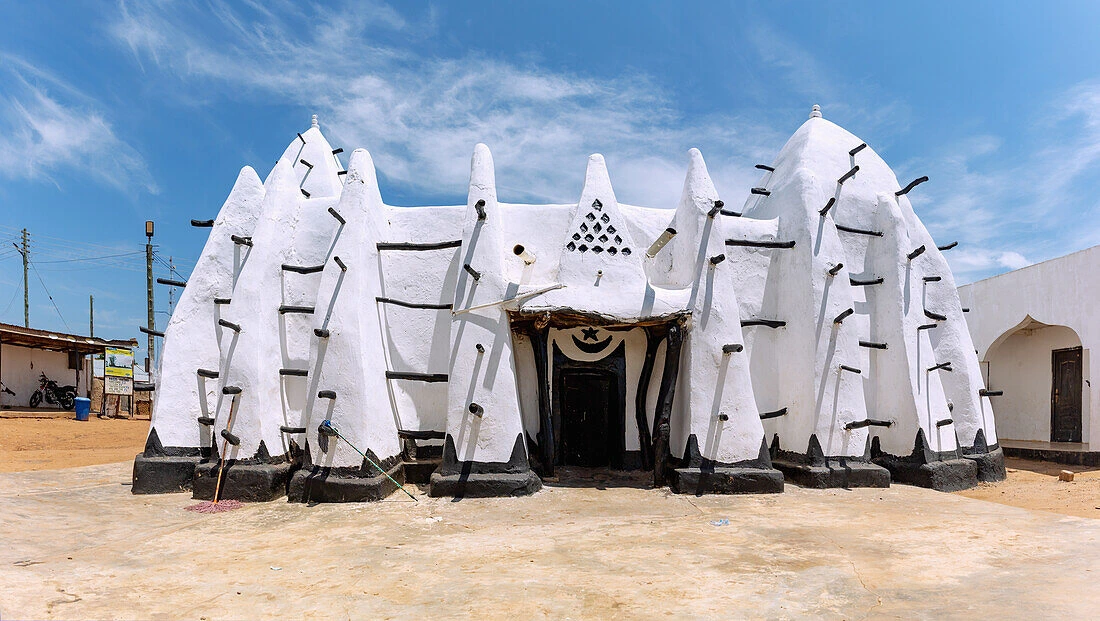
In the remote Savannah Region of northern Ghana stands a structure that defies conventional historical narratives—the Larabanga Mosque, a mud-and-stick edifice that has endured six centuries of sun, storm, and social upheaval. Recognized as the oldest mosque in Ghana and one of the oldest in West Africa, this architectural marvel dating to 1421 represents not merely a place of worship but a confluence of history, legend, and unwavering faith that continues to captivate scholars, pilgrims, and travelers alike.
Historical Foundations
The Larabanga Mosque was constructed in 1421 during the trans-Saharan trade era, a period when Islamic scholarship and commerce flourished across West Africa. Built in the traditional Sudano-Sahelian architectural style—characterized by timber reinforcements protruding from its whitewashed mud walls—the mosque shares stylistic kinship with the great mosques of Timbuktu and Djenné in Mali. This architectural tradition, developed over centuries in the Sahel region, utilizes readily available materials and incorporates timber beams that serve both structural and maintenance purposes, allowing for the periodic re-plastering necessary in regions with dramatic seasonal variations.
The village of Larabanga itself served as a significant stopover for traders traveling ancient caravan routes, and the mosque became a spiritual anchor for Muslim merchants and clerics moving between the forest kingdoms to the south and the Sahelian empires to the north. Its location near what is now Mole National Park positioned it strategically along these commercial and religious networks.
The Legend of Divine Construction
The founding narrative of Larabanga Mosque transcends ordinary architectural history and enters the realm of the miraculous. According to oral tradition meticulously preserved by generations of custodians, an Islamic scholar and traveler named Ayuba received a divine vision instructing him to build a mosque at this specific location. When he awoke from his dream, he discovered that the foundation of the mosque had been mysteriously laid overnight, with no human intervention.
This account, while existing beyond empirical verification, speaks to the profound spiritual significance the community has always attached to the site. Ayuba’s role transformed from architect to completionist—he did not initiate the construction but rather finished what divine providence had begun. This narrative has been passed down through the Braimah family, who have served as hereditary custodians of the mosque for generations, maintaining both the physical structure and the sacred traditions associated with it.
The Celestial Qur’an
Among the mosque’s most treasured possessions is an ancient Qur’an believed by the local community to have descended from heaven in 1650. This manuscript, regarded as both relic and miracle, is kept secured throughout the year and revealed to the public only during the annual Fire Festival (Jinkula), a significant event in the community’s religious calendar.
The sacred text has become an object of veneration in its own right, with devotees attributing to it protective and intercessory properties. While the manuscript’s actual origins remain a matter of faith rather than documentary evidence, its presence has made Larabanga a pilgrimage destination for Muslims throughout the region. The careful preservation of this Qur’an over more than three centuries demonstrates the community’s dedication to safeguarding its spiritual heritage.
The Mystic Stone
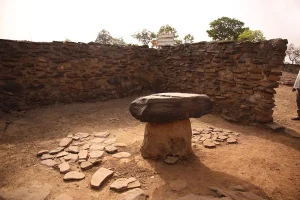
Perhaps no element of Larabanga’s mystique has captured modern imagination quite like the story of the Mystic Stone, a tale that brings together colonial-era engineering, spiritual belief, and an outcome that defies conventional explanation.
In the 1950s, during the British colonial period, road construction crews were tasked with building a highway that would improve transportation infrastructure in northern Ghana. Their planned route ran directly through a large stone located near the Larabanga Mosque—a stone the local community had long regarded as spiritually significant, marking the spot where early Islamic leaders of the settlement were said to have received divine messages and guidance.
The construction team, viewing the stone as merely an obstacle, employed bulldozers and heavy machinery to move it aside, clearing the path for the road. However, workers arriving the following morning discovered the stone had returned to its original position. Attributing this to error or natural settling, the crew moved the stone again, applying greater force and taking additional precautions to ensure it would remain displaced.
The next day, the stone was back.
A third attempt yielded identical results. According to both local testimony and accounts that have entered the historical record of the region, the British engineers and construction supervisors ultimately conceded defeat. Rather than continue the increasingly futile struggle, they redesigned the highway to curve around the stone, which remains in its original location to this day—a hump in the modern road serving as a physical testament to the limits of technological determination when confronted with forces, whether spiritual or otherwise, that refuse to yield.
The Mystic Stone has since become a site of pilgrimage in its own right. Visitors and community members come to pray for healing from illness, safe childbirth, protection during travel, and financial breakthroughs. The stone’s refusal to be moved has been interpreted as a sign of the sacred nature of the ground upon which it rests, reinforcing the belief that Larabanga occupies a space where the boundary between the material and spiritual worlds grows thin.
Architectural Significance and Preservation Challenges
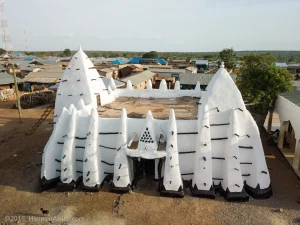
From an architectural standpoint, the Larabanga Mosque exemplifies the ingenuity of Sudano-Sahelian design. Its walls, constructed from mud bricks and reinforced with timber, require annual maintenance—a process that has traditionally involved the entire community in re-plastering the exterior after the rainy season. This participatory maintenance is not merely practical but ceremonial, strengthening communal bonds and ensuring the transmission of traditional building techniques to younger generations.
The mosque features two towers of unequal height, with the taller eastern tower oriented toward Mecca. The protruding timber beams serve multiple purposes: they provide structural support, create permanent scaffolding for maintenance work, and contribute to the building’s distinctive aesthetic profile.
However, the mosque faces ongoing preservation challenges. Increased rainfall variability due to climate change threatens the integrity of mud-brick structures throughout the Sahel. In 2002, the mosque was placed on the World Monuments Watch List of endangered sites, drawing international attention to its precarious condition. Restoration efforts have since been undertaken, balancing the need for structural stabilization with the imperative to preserve traditional materials and techniques.
The tension between preservation and modernization remains delicate. Well-intentioned interventions using cement and modern materials can actually accelerate deterioration of mud-brick structures by altering moisture dynamics and creating inflexible surfaces that crack under stress. Successful preservation therefore requires not just financial resources but deep understanding of traditional construction methods.
Cultural and Economic Impact
The Larabanga Mosque has become a cornerstone of cultural tourism in northern Ghana. Its proximity to Mole National Park, Ghana’s largest wildlife refuge, creates a natural pairing for tourists seeking both natural and cultural experiences. This tourism brings economic benefits to the community while raising awareness of northern Ghana’s rich Islamic heritage, often overshadowed in national narratives by the coastal slave forts and Ashanti cultural sites.
The mosque serves as a living reminder that Ghana’s history is multifaceted, encompassing not only the Atlantic trade and colonial experience but also centuries of trans-Saharan Islamic influence that shaped the social, commercial, and spiritual landscape of the interior regions. For Ghana’s Muslim population, Larabanga represents a tangible link to the deep roots of Islam in West Africa, predating European contact by centuries.
Conclusion
The Larabanga Mosque stands as more than an architectural curiosity or tourist attraction. It represents a living intersection of documented history and oral tradition, of empirical observation and spiritual conviction. Whether one interprets the founding legend as metaphor, miracle, or folk memory, the mosque’s survival through six centuries of political upheaval, environmental stress, and social change is itself remarkable.
The story of the Mystic Stone, similarly, transcends questions of literal truth to address deeper themes about the relationship between human ambition and forces—natural, cultural, or spiritual—that resist domination. That a modern highway curves around an ancient stone is a documented fact; the interpretation of why this occurred remains a matter of perspective.
What remains indisputable is that Larabanga continues to function as it has for six hundred years—as a place of prayer, a repository of tradition, and a testament to the enduring human capacity to create spaces where the sacred and the everyday coexist. In an era of rapid modernization and cultural homogenization, the mosque stands as a reminder that some foundations, once mysteriously laid, prove impossible to displace.
The building that started itself, the stone that refused relocation, and the community whose history is inscribed in layers of mud, faith, and memory—together they form a narrative uniquely Ghanaian, yet speaking to universal human experiences of wonder, persistence, and the search for meaning in a world where not everything can be explained, and perhaps not everything should be.