
Can a Museum Built from Earth and Colonial Remnants Revolutionize Access to Art and Education?
When artist Ibrahim Mahama inaugurated Red Clay Studio on September 5, 2020, in Janna Kpeŋŋ, near Tamale, Ghana, he launched a radical experiment in cultural democracy. This 200-acre project challenges fundamental assumptions about who museums serve, what they should contain, and how they operate. In a region where access to world-class cultural institutions remains severely limited, Red Clay represents both an artistic statement and a social intervention, transforming abandoned colonial infrastructure into platforms for community empowerment.
Born in Tamale in 1987, Mahama rose to international prominence through large-scale installations using jute sacks—the material once used to transport Ghana’s cocoa during the colonial era. His work, exhibited at the Venice Biennale, Documenta, and the Centre Pompidou, explores globalization, labor, and colonial legacies. Rather than maintaining his practice exclusively within elite international circuits, Mahama redirected resources from his global success back into his hometown, creating an institutional ecosystem: the Savannah Centre for Contemporary Art (SCCA, 2019), Red Clay Studio (2020), and Nkrumah Volini (2021).
Architecture
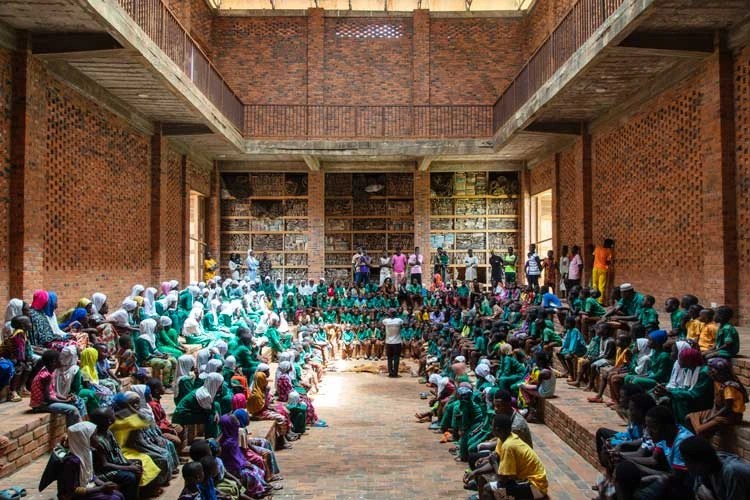
The name “Red Clay” derives from the burnt-umber earth of northern Ghana, the primary building material of the complex. In a continent where modern architecture often relies on imported concrete and glass that trap heat, Mahama’s choice represents a rejection of architectural colonialism. Working with local masons, he created deep red bricks fired and stacked to allow natural ventilation. The thousands of tiny holes perforating these bricks serve dual purposes: they function as natural air conditioning while providing sanctuary for thousands of bats that emerge at sunset in spectacular clouds.
This architectural philosophy demonstrates what Mahama calls “time travel”—rerouting colonial and postcolonial residues to create new opportunities. The warehouse-sized buildings embody the principle that the most valuable resources are found beneath one’s feet, not imported from abroad.
Recovering Relics
For over a decade, Mahama tracked down Ghana’s abandoned colonial-era trains, which sat rusting in tall grass across southern Ghana. These locomotives and carriages, once used by British colonial authorities to extract minerals and timber, had become forgotten relics. Through Ghana’s Ministry of Railway Development and scrap dealers, Mahama acquired these trains and orchestrated their transportation hundreds of miles to Tamale—a logistically extraordinary feat.
Among these artifacts is a luxury carriage that carried Queen Elizabeth II during her 1961 visit, just four years after independence. The irony is profound: a symbol of colonial power now sits in northern Ghana’s red dust, accessible to communities it once passed through as an instrument of empire. This transformation exemplifies Mahama’s vision of reclamation.
The recovered train seats found new purpose in “The Parliament of Ghosts,” comprising 120 second-class seats arranged as a parliamentary chamber. Originally exhibited at Manchester’s Whitworth Art Gallery in 2019, the installation is now permanently housed at Red Clay. The “ghosts” are memories and labor of thousands of ordinary Ghanaians who occupied those seats across decades. Unlike traditional parliaments where officials make distant decisions, this space belongs to youth and local residents—a forum where history is experienced physically.
Mahama’s boldest intervention involved acquiring six retired Soviet-era airplanes and transporting these massive metal giants through villages and across the savannah to Tamale. For many Northern Ghanaian children, airplanes exist only as distant white streaks in the sky, representing inaccessible technology and mobility.
By transforming these aircraft into classrooms and libraries, Mahama enabled children who have never visited airports to climb into pilot seats, manipulate controls, and engage with history and science. This challenges psychological limitations imposed by geographical marginalization. If a Soviet jet serves as your classroom, the wider world becomes tangible and accessible.
Open Access Education
Red Clay operates without admission fees or barriers, providing free educational programming to approximately 2,000 school children weekly. The curriculum extends beyond arts education to include robotics, solar energy, drone piloting, coding, and interdisciplinary creative activities. This comprehensive approach reflects Mahama’s conviction that access to culture and technical skills should not be geographically or economically limited.
The space functions simultaneously as Mahama’s personal studio and public resource—a hybrid dissolving boundaries between artistic production and community engagement. Visitors encounter groups studying 3D printing while others examine archival photographs of colonial-era railway workers. No gates restrict access; no institutional barriers suggest exclusion.
International Recognition
Mahama’s community-centered work earned him the prestigious Principal Prince Claus Award in 2020, valued at €100,000. He joined previous Ghanaian laureates including ethnomusicologist J.H. Nketia (1997) and artist El Anatsui (2009). His international career provides economic foundation for local initiatives.
Mahama’s works appear in collections at the Los Angeles County Museum of Art, the National Gallery of Art in Washington, and the Centre Pompidou. Recent solo exhibitions include Kunsthalle Wien (2025), the Barbican Centre (2023-2024), and the High Line in New York (2021). In 2023, he became the first African artist to direct the Ljubljana Biennale of Graphic Arts.
Many exhibitions draw titles from African literature—works by Ayọ̀bámi Adébáyọ̀, Chimamanda Ngozi Adichie, and Ayi Kwei Armah—embedding his visual work within broader African intellectual traditions.
Repurposing Failed Promises
The institutions address unrealized promises of Ghana’s post-independence era. Nkrumah Volini takes its name from abandoned grain silos from the Kwame Nkrumah era (1957-1966), built for food security and economic self-reliance but never completed. By repurposing these structures, Mahama creates what he terms “a site for dialogue and debate, taking historical failures as a starting point for new ideals and economic change.”
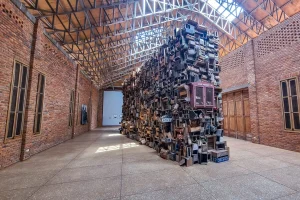
Red Clay makes no distinction between high and low culture, archive and artwork, education and exhibition. Old electricity transformers await transformation into installations. Sewing machines on school desks operate at a pedal’s press, honoring garment workers’ labor. Exhibitions feature both internationally recognized photographers like James Barnor and emerging Ghanaian artists exploring post-independence narratives.
Bridging Worlds
Mahama’s outreach extends beyond physical spaces. Since 2008 as an art student at Kwame Nkrumah University of Science and Technology, he has engaged local audiences. Recently, he traveled over an hour to deliver lectures at Zugu Dabogni AME Zion Primary School, speaking in Dagbani, the Northern Region’s local language. When the headmaster thanked him for “bringing the world closer,” Mahama responded: “They are part of the world, but we have to learn to bridge the gap.”
This philosophy—bridging local and global, past and future, elite and popular—animates Red Clay’s operations. The institution recirculates global resources to serve local needs while maintaining international connections, rather than extracting community value for international audiences.
Conclusion
Red Clay Studio fundamentally challenges museums as neutral culture containers. Instead, it demonstrates institutions can actively produce possibility, reimagine social relations, and empower communities. By building with local earth, repurposing colonial remnants, and providing free cutting-edge education, Mahama proves cultural institutions need not replicate Western models to achieve excellence.
The project embodies a crucial principle: culture is not a luxury but a basic need. In a region where children might never visit Paris or London museums, Mahama created a space where Soviet airplanes become classrooms, colonial carriages become democratic forums, and thousands of bats find sanctuary in bricks sheltering human creativity.
During COVID-19, Mahama contributed to Designboom’s “Messages of Hope”: “The promises of the present can start with ghosts from both the future and past. Ghosts are an embodiment of failed revolutions and unrealized futures, which need to be used as a starting point for new conversations within this century and beyond. Every life form is a gift.”
Red Clay is not simply a museum—it is testament to what becomes possible when artists refuse to accept that culture belongs to distant capitals. It represents proof that art transcends wall-hung paintings: it can be forests, schools, reclaimed trains, and transformed futures. In Tamale’s red earth, Mahama has built not just buildings but a vision of cultural democracy challenging the world to reconsider what institutions can be and whom they exist to serve.