

Ever wondered how it’d feel to look into the eyes of history and find yourself staring back?
In the farmlands of Nuhalenya-Ada, approximately two hours east of Accra, Ghana, this question transforms from philosophical inquiry into visceral experience. The Nkyinkyim Museum, founded in 2019 by renowned Ghanaian artist and cultural activist Kwame Akoto-Bamfo, represents a radical departure from conventional historical institutions. Here, visitors do not merely observe artifacts behind glass barriers or read sanitized plaques recounting sanitized narratives. Instead, they walk among thousands of sculpted heads embedded in the earth, each one a witness to stories that colonial powers attempted to erase, each face a testament to ancestors who were forcibly displaced, commodified, and silenced.
This is not simply a museum. It is Ghana’s largest outdoor memorial, a sacred space of restorative justice, and an ongoing act of cultural resistance that challenges visitors to confront the uncomfortable truths about Africa’s past while participating in collective healing for its future.
Kwame Akoto-Bamfo, born in 1983 and raised between Accra and Ghana’s Eastern Region by his single mother and grandmother, absorbed traditional Ghanaian culture and African philosophy from village life. His artistic journey began early beecause he drew constantly at a younger age. By age four, it was evident that art would define his path. But Akoto-Bamfo’s artistic ambitions extended far beyond personal expression or what his mother hoped would be a “gentleman artist who would bring prestige to the family.”
Instead, Akoto-Bamfo became a multi-disciplinary artist, educator, and activist whose work confronts the most painful chapters of African history. His grandmother shared stories of kidnappings during the slave trade era. He touched shackles and chains passed down through families. These experiences crystallized into a singular purpose: to use art as a vehicle for memory preservation, healing, and restorative justice for people of African descent worldwide.
In 2009, Akoto-Bamfo began the Ancestor Project, the organizational framework through which he would archive oral history and traditions through sculpture. This initiative would eventually give birth to the Nkyinkyim Museum and its centerpiece, the Nkyinkyim Installation, which is an evolving collection that currently comprises over 3,500 sculptures spread across three continents, with an ambitious goal of completing 11,111 pieces.
The number 11,111 is deliberate, representing strength in numbers and the millions of Africans lost to the transatlantic slave trade. Depending on fundraising and resources, this monumentally ambitious project could take up to a decade to complete, but its impact is already reverberating globally.
The Symbolism of Nkyinkyim
The museum’s name carries profound significance. “Nkyinkyim” derives from an Akan Adinkra symbol meaning “twisted” or “intertwined,” connected to the proverb stating that “life’s journey is twisted.” This symbolism operates on multiple levels within the museum’s philosophy and physical design.
First, it acknowledges the unpredictable, winding nature of African history marked by flourishing civilizations, brutal colonialism, forced displacement, resistance movements, and ongoing struggles for authentic independence. The twists and turns represent not only historical trajectories but also the migration journeys of enslaved ancestors and the physical layout of the installation itself, which follows a serpentine, wall-like structure guiding visitors through chronological segments of African experience.
Second, the symbol reflects the museum’s mission to untangle and make visible the complex interconnections between past trauma and present realities, between Africans on the continent and those in the diaspora, between historical erasure and cultural reclamation.
The Nkyinkyim Archive
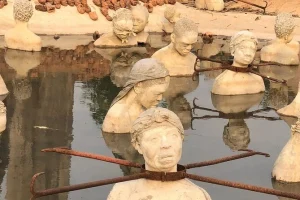
At the heart of the museum lies the Nkyinkyim Installation, an ever-evolving work of staggering scope and emotional power. The installation currently features over 1,500 life-sized concrete heads and 3,000 miniature terracotta heads, each representing individuals who were captured, imprisoned, traded, and transported across the Atlantic during the slave trade.
These are not idealized or abstract representations. Drawing on nsodie, the ancient Akan funeral tradition dating back to at least the 17th century in which sculptors (often women) created clay busts to preserve the memory and likeness of the dead, Akoto-Bamfo’s sculptures display raw, unfiltered human emotion. Visitors encounter faces expressing shock, horror, anger, fear, sadness, and disgust. The heads depict young and old, male and female, members of different ethnic groups. This was a deliberate acknowledgment that slavery did not discriminate, that entire communities were decimated.
What makes this installation particularly haunting is Akoto-Bamfo’s methodology. He uses the faces of contemporary people of African descent to model these sculptures, creating a direct, visual bridge between ancestors and their living descendants. As American-born African artist Nikesha Breeze, who has worked with the museum since 2021, explains: “Countless times we’ve had visitors crying because they come here and find sculptures that look exactly like them.”
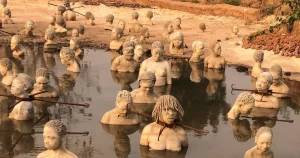
The sculptures are positioned at ground level, many buried from the neck down, simulating masses of people interred in the earth. Some have been placed in nearby bodies of water, evoking those who drowned during the Middle Passage. Streaks of red and copper rust from chains flow down the sculptures like blood, a visceral reminder of the physical brutality inflicted upon millions.
The installation is deliberately incomplete, constantly growing. Artists, apprentices, and volunteers from Accra and Nuhalenya-Ada work throughout the year creating new pieces, their labor visible in the museum’s workshop where visitors can witness the dedication and skill required to bring each face into being.
A Living Museum Experience
What distinguishes Nkyinkyim from conventional museums is its integration of intangible cultural heritage. The experience seamlessly combines sculpture with drumming, dancing, and traditional healing rite. This is not a static collection but a living, breathing cultural ecosystem.
Central to the museum experience are the griots – trained storytellers and cultural custodians who guide visitors through the grounds. Since 2019, the museum’s Griot Learning Program has graduated six griots who possess deep knowledge of the history, symbolism, spirituality, and philosophy embodied in the sculptures. Unlike traditional museum docents who might simply recite facts, griots employ performance and oral tradition to convey meaning, creating an immersive narrative journey.
Visitors are led through various installations including the 100-meter History Wall representing Love, Activism, and Healing, which features relief carvings and freestanding sculptures arranged chronologically to highlight precolonial civilizations, the transatlantic slave trade, resistance movements, liberation struggles, and contemporary cultural revival.
The museum grounds also feature “The Blank Slate” sculpture, unveiled on August 7, 2021, inspired by Elizabeth Alexander’s book “The Trayvon Generation.” This work connects historical enslavement to contemporary struggles for racial justice, explicitly linking the ancestors’ suffering to modern movements like Black Lives Matter and protests following George Floyd’s murder.
At the conclusion of tours, visitors encounter a bell. They are invited to ring it if they believe they have learned something and commitment to carrying forward the knowledge they’ve gained.
Sacred Practices and Restorative Justice
The Nkyinkyim Museum functions as sacred ground where traditional spiritual practices are not only permitted but encouraged. Traditional priests perform libations, honoring the ancestors represented in the sculptures. The museum’s Sacred Area now features 11,111 unique heads arranged with small huts in a circle for ancestral protection. Visitors to this area must adhere to traditional practices including removing shoes, knocking before entering, pouring libations, and refraining from selfies and photography that might commercialize or undermine sacred funerary art practices.
The annual Ancestor Veneration Ceremony has become a cornerstone event, drawing Chiefs, diplomats, academics, diaspora visitors, and community members to participate in rituals that close the circle of rites around African traditional funerary arts. These ceremonies have opened to include various African ethnic groups beyond the Akan, creating pan-African spaces for healing and remembrance.
This emphasis on sacred practice represents a radical reclamation. European colonialism systematically demonized and suppressed African ancestor veneration and traditional burial customs, misrepresenting them as linked to evil. By reviving these endangered art forms and practices, Akoto-Bamfo and the Nkyinkyim Museum assert the validity, beauty, and spiritual power of African cultural traditions.
The museum’s commitment to restorative and transformative justice extends beyond mere acknowledgment of historical trauma. It provides structured opportunities for healing, education, and empowerment. Special programs including pilgrimages, academic tours, art residencies, rites of passage, and specific rituals must be pre-booked, allowing the museum staff to create carefully designed experiences tailored to visitors’ needs.
A Journey Through History: From Faux-Reedom to International Recognition
The Nkyinkyim Installation’s public journey began provocatively during Ghana’s 60th Independence Day celebration in 2017. Akoto-Bamfo “outdoored” (publicly unveiled) over 1,200 concrete portrait heads at the Kwame Nkrumah Mausoleum in an exhibition titled “Faux-Reedom.” The title and location were deliberately chosen to pose an uncomfortable question: Is Ghana, the first African colony to gain independence from European rule, truly free from the legacies of slavery and colonization?
This bold challenge to triumphalist narratives of independence established Akoto-Bamfo’s work as operating at the intersection of art and activism. Following the exhibition, the sculptures remained at Nkrumah’s tomb for three months before being moved to Ussher Fort, a former slave fort later converted into a prison—another symbolically loaded location connecting historical and contemporary forms of captivity.
In 2017, Cape Coast Castle, one of Ghana’s most significant slave trading fortifications and now a UNESCO World Heritage Site, hosted the Nkyinkyim Installation in an exhibition titled “Portraits of the Middle Passage, In Situ,” curated by Fulbright Scholar Danny Dunson. For one year, the funerary sculptures inhabited the dungeons where enslaved Africans were held captive in the weeks before their trans-Atlantic voyage to lives of servitude, bringing the faces and humanity of the ancestors directly into the spaces of their suffering.
The installation’s most prominent international extension came in 2018 when 111 sculptures from the Nkyinkyim collection were installed at the National Memorial for Peace and Justice in Montgomery, Alabama, created by Bryan Stevenson’s Equal Justice Initiative. Standing at the memorial’s entrance, a grouping of seven shackled figures of three males, three females, and a baby greets visitors, establishing the memorial’s emotional tone and grounding its narrative in the lived experiences of enslaved people.
This sculpture, also called Nkyinkyim, depicts interconnected yet isolated figures with rust-colored stains flowing from their chains like blood. Stevenson, who discovered Akoto-Bamfo’s work through a crowdfunding platform while searching globally for the right sculptor, was “completely blown away” by the emotional power of the pieces. Notably, Akoto-Bamfo’s visa application to attend the memorial’s April 2018 opening was denied, forcing him to direct the installation remotely.
Akoto-Bamfo’s work has also appeared at the Legacy Museum in Montgomery and toured major American cities through his “Blank Slate Monument,” visiting Louisville, Times Square in New York, and the King Center in Atlanta, among other locations. These extensions ensure that the Nkyinkyim Installation reaches diverse audiences, creating dialogues between Africans on the continent and the diaspora.
Contemporary Relevance and Global Impact
The Nkyinkyim Museum exists in productive tension between honoring the past and addressing present realities. While the installation prominently commemorates enslaved ancestors, it explicitly connects their suffering to contemporary manifestations of racial injustice, including police violence, mass incarceration, and systemic inequality.
Akoto-Bamfo has been clear that his work engages not only with historical slavery but with ongoing struggles. The museum features exhibits on George Floyd alongside historical materials about the transatlantic slave trade, recognizing the eternal plight of Black communities abroad and the continuities between historical and contemporary forms of anti-Black violence.
This approach has made the Nkyinkyim Museum particularly significant for diaspora visitors participating in Ghana’s “Year of Return” (2019) and “Beyond the Return” initiatives. For African Americans and other diaspora members seeking to reconnect with their roots, the museum offers something profoundly different from the trauma tourism often associated with slave castle visits. While places like Elmina and Cape Coast Castles force visitors to imagine the horrors that occurred within their walls, Nkyinkyim provides detailed visual reminders of individual faces, stories, and humanity making the collective anguish deeply personal and immediate.
The museum’s location in rural Nuhalenya-Ada, spreading across several acres of farmland, contributes to this transformative experience. The peaceful, contemplative environment allows for deep reflection while the sheer scale of the installation of thousands of heads spreading across the landscape conveys the magnitude of lives lost in ways that numbers in history books cannot.
Challenges, Controversies, and Conversations
The Nkyinkyim Museum’s approach is not without complexity. By using contemporary African faces to model sculptures of enslaved ancestors, Akoto-Bamfo creates powerful connections but also raises questions about representation, trauma, and the ethics of depicting suffering.
The museum’s explicit challenge to Ghana’s independence narrative – questioning whether the nation has truly freed itself from colonial legacies – has sparked important conversations about neo-colonialism, economic dependency, and the incomplete nature of political liberation without cultural and economic sovereignty.
Additionally, the museum’s emphasis on sacred practices and restrictions on photography in certain areas can create tension with contemporary expectations around documentation and social media sharing. However, these restrictions serve a crucial purpose: they insist that visitors engage with the space and sculptures as sacred objects deserving reverence rather than as backdrops for selfies or Instagram content.
The museum’s acknowledgment of African complicity in the slave trade also demonstrates intellectual honesty that some find uncomfortable. As Akoto-Bamfo notes, “Where we were wrong, we say it.” This willingness to address indigenous slavery in Africa and the role of African merchants and rulers in the transatlantic trade challenges simplified narratives that position Africans solely as victims, instead presenting a more complete, if more troubling, historical picture.
Conclusion
In an era where historical narratives are contested, revised, and sometimes deliberately obscured, the Nkyinkyim Museum serves as an essential counterforce to erasure. Its thousands of sculpted faces perform the crucial work of making visible what systems of power have attempted to render invisible: the individual humanity of millions of enslaved Africans, the specific faces and expressions of people who lived, suffered, resisted, and whose descendants continue to navigate the reverberations of their ancestors’ trauma.
But Nkyinkyim offers something beyond documentation. By creating sacred space for grief, remembrance, and healing; by employing griots to transmit knowledge through oral tradition; by incorporating traditional rites and contemporary artistic practices; by connecting historical injustices to present struggles; and by inviting visitors to become participants rather than passive observers, the museum models what restorative and transformative justice might look like in practice.
The question posed at the beginning remains: What does it mean to look into the eyes of history and find yourself staring back? At Nkyinkyim Museum, the answer becomes clear. It means recognizing that we are the living continuation of stories that were almost silenced. It means understanding that healing requires confronting uncomfortable truths. It means accepting responsibility for carrying these narratives forward. And it means transforming memory from passive recollection into active force for justice, dignity, and cultural reclamation.
Visitors do not leave Nkyinkyim the same way they entered. They leave with thousands of eyes still watching, thousands of stories still speaking, and the weight of remembrance transformed into something both precious and necessary; which is the commitment to ensure that these ancestors, these stories, this history will never again be forgotten or erased.